CUPED makes A/B tests detect smaller effects without needing more users. Each user’s experiment-period metric is partly predictable from their pre-experiment behavior; subtracting that predictable part leaves a smaller residual, and a smaller residual variance means a smaller MDE (minimum detectable effect).
CUPED (Controlled-experiment Using Pre-Experiment Data) reduces variance in randomized online experiments by regressing out variation explained by pre-experiment user behavior. The underlying technique is control-variate adjustment applied to A/B tests; see AB Tests for the parent topic.
Formula
flowchart LR
    Pre[Pre-period:<br/>observe X_pre] --> Assign[Random<br/>assignment]
    Assign --> Exp[Experiment period:<br/>observe Y per arm]
    Exp --> Adj["Adjust: Y_cuped =<br/>Y − θ(X_pre − X̄_pre)"]
    Adj --> Cmp[Compare arms<br/>on residual]
CUPED regresses the experiment-period metric on a pre-period covariate and analyzes the residual:
where:
- is the experiment-period metric.
- is a covariate measured pre-assignment (typically the same metric, or a correlated one, measured during a pre-experiment window).
- is the pooled mean of across arms.
- is the optimal control-variate coefficient.
is unbiased for the average treatment effect because treatment is randomized and is measured before assignment.
Variance reduction
Variance of the adjusted estimator scales with , where is the correlation between and :
So yields 9% variance reduction; yields 51%; yields 81%.
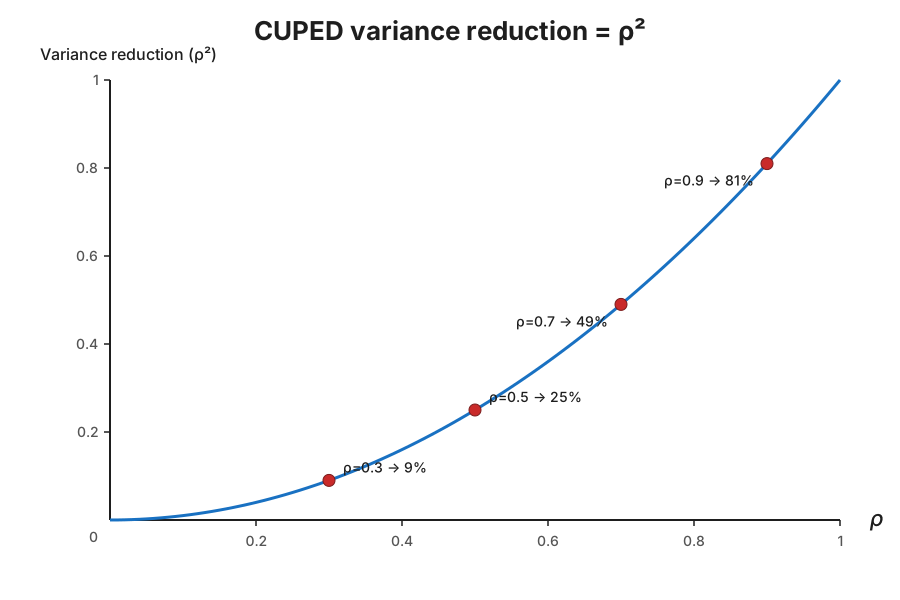
Deng et al. (2013) report 30–70% variance reduction on the Microsoft metrics they studied (sessions, revenue), corresponding to roughly 0.55 to 0.84. Realized reduction on other metrics depends on the specific autocorrelation structure.
Choosing the covariate
The standard covariate is the same metric measured pre-period. Alternatives:
- A related metric with higher autocorrelation.
- A sum of multiple pre-period signals.
- A model prediction of trained on pre-experiment features (see CUPAC below).
The covariate must be measurable before treatment assignment. A pre-assignment covariate is independent of treatment by construction, which preserves unbiasedness of the estimator.
CUPAC
CUPAC (Control Using Predictions As Covariates) generalizes CUPED by replacing the linear covariate with an ML model trained on pre-experiment features:
where is the model prediction of the experiment-period outcome from pre-experiment features only. Variance reduction still scales with , now measuring the correlation between and .
The gain over CUPED scales with how much better the ML model predicts than a single linear covariate does. The predictor must use only pre-treatment information; leakage risk is higher than with CUPED because a flexible model can accidentally ingest post-assignment signal if feature pipelines are not audited.
Relationship to stratification
CUPED is a special case of regression adjustment on baseline covariates. Stratified assignment balances a covariate across buckets at assignment time; post-stratification regresses on the covariate after the fact. CUPED is post-stratification with a continuous covariate and an optimal weighting.
Under randomization, post-stratification is asymptotically equivalent to pre-stratification; in finite samples with imbalanced segments, pre-stratification is more reliable because it forces balance rather than estimating it.
When CUPED underperforms
- New users with no pre-period behavior: the covariate is undefined or zero, so the regression has no traction.
- Metrics driven by novelty or one-off events: correlation with past behavior is weak.
- Rare-event metrics: the pre-period base rate is too low to produce a usable covariate.
- Metrics with a different population in the experiment window than in the pre-period (seasonal onboarding, region launches).
Common pitfalls
- Including post-assignment features in . Breaks unbiasedness; inflates reported variance reduction while corrupting the average treatment effect (ATE) estimate.
- Computing per-bucket instead of pooled. The covariate mean must be pooled across arms.
- Treating CUPED as a universal variance halver. The gain is entirely driven by ; at the variance reduction is only 9%.
- Confusing CUPED with counterfactual variance reduction on observational data. CUPED works because randomization guarantees the covariate is independent of treatment; applying the same math to non-randomized data does not produce the same guarantees.
Links
- Deng, Xu, Kohavi, Walker — CUPED (2013). The original paper.
- Kohavi, Tang, Xu — Trustworthy Online Controlled Experiments (Cambridge University Press, 2020). Chapter on variance reduction covers CUPED and CUPAC with implementation guidance.